
AI and cybersecurity risks, simpified
Nowadays, AI is impossible to ignore within organisations: it is used in varying degrees to improve productivity and quality and to reduce costs. Even if an organisation has decided not to do anything with AI, it will still be used by employees. Whether one wants it or not: AI is not going away any time soon. However, the use of AI brings with it various unknown risks and challenges.
AI within organisations in practice
Organisations are also increasingly deploying AI within their own business processes. Well-known examples include chatbots for customer service, the use of AI in telephone menu systems, and process automation. As a result, AI is becoming an increasingly integral part of day-to-day operations.
Cybersecurity and data risks of AI use
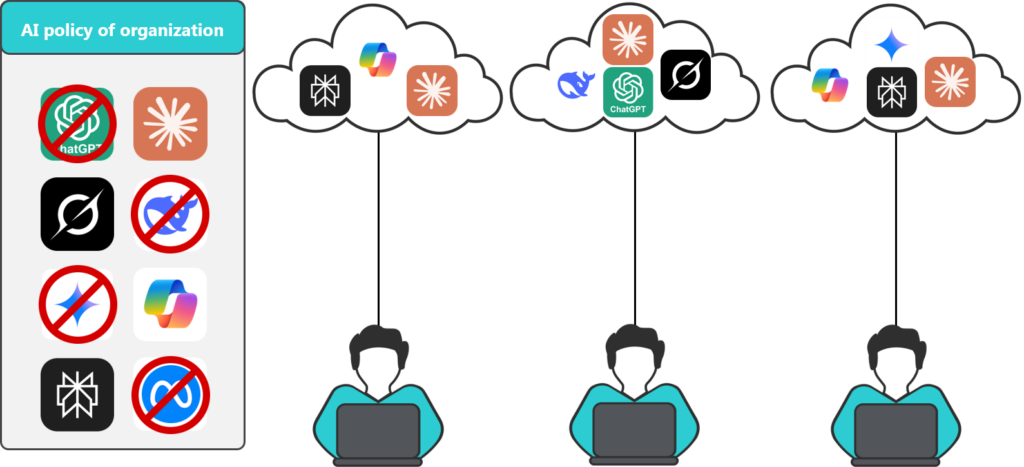
To manage these risks effectively, it is essential to gain insight into how employees use AI, which AI is being used, and how this can be made safer. Some of the risks include: the rise of shadow AI, data leaks due to a lack of masking of sensitive data, and the use of free AI models
Shadow AI
A simple example of this works as follows:
An employee is dissatisfied with the AI result from the AI approved by the organisation and runs it once more through their own free ChatGPT account to get the desired result. This can of course be prevented by blocking the unwanted AI in the firewall, but the employee then uses their phone as a hotspot via 4G or 5G, thereby bypassing the organisation’s security policy and measures; unfortunately, this is not a problem that is easy to solve.
Legislation and regulation
In addition, an important point of attention is preventing sensitive information from being unintentionally leaked via AI applications. This is where the application of Data Loss Prevention (DLP) measures becomes important. As mentioned earlier, a leak can occur quickly, but the resulting damage can, in some cases, have long-lasting consequences.
Controls and alternatives
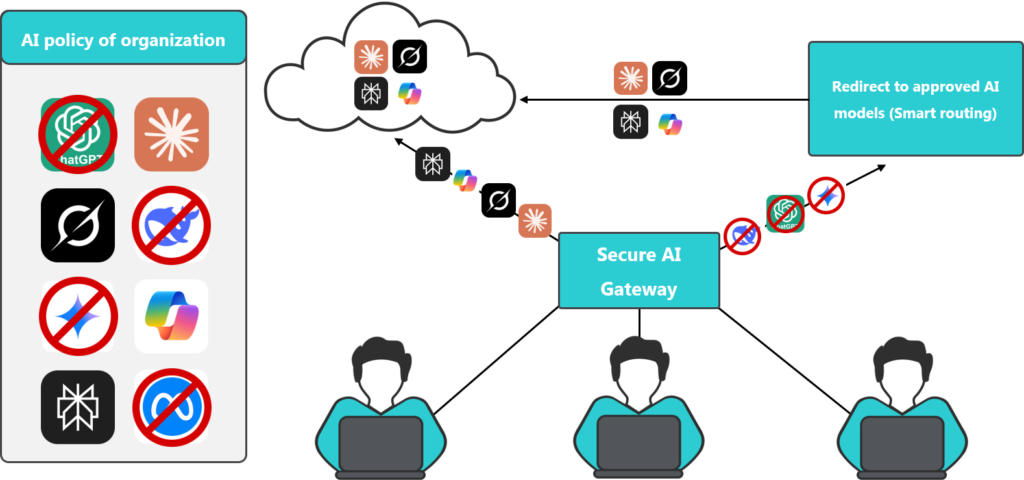
The Secure AI Gateway provides:
- Visibility into the use of Shadow AI
- Coordination of Shadow AI users towards approved AI
- Filtering of sensitive information submitted to the AI
- Data Loss Prevention (DLP)
- Hallucination protection on AI-provided information, preventing flawed decision-making based on nonsensical answers
- Cost reduction on paid AI subscriptions
- The ability to offer and compare multiple AIs simultaneously, Multi LLM
- Support for external and internal AI platforms such as ChatGPT, Gemini, Copilot, on-prem GPT box, Bedrock, Azure OpenAI, Vertex, etc.
Who are we?
Do you know what's leaving your organisation through AI?
Chances are employees are already using AI beyond your visibility. We map this out and show you how to regain control
Schedule a free consultation:· +31 70 355 8478 or get in touch with us using the button below.